I have been thinking about my blog:
Should I seperate my book reviews and other comments into two seperate blogs? Vote on the poll.

Tell Me a Story, Raggedy Man
Monday, May 31, 2010

Monday, May 24, 2010
Talented...
The folk of a distant land came together to create a mighty statue. If all their gifts were woven together in the making, the statue would come to life, bringing great blessings to the land.
But one girl, nearly a woman, could not discover her role in the task. Her lesser gifts—cooking, cleaning, childcare—were valued and necessary, but her deepest, strongest gift remained hidden. And the girl’s heart ached, for the starlight of her true gift seemed shrouded by the candles of lesser skills.
Even when she found others gifted with the same craft, her confusion grew. Was she sharing her gift to enrich others, or merely seeking glory? Why was her role so difficult to discover? For she longed to contribute to the statue.
Although her parents attempted to support her, their need of explanations undermined their efforts. For a gift that must be explained is lacking in power and usefulness.
The girl never doubted that her gift had power, for it was this gift, used by others, that uplifted her heart in dark times. Yet of what worth is power without a purpose?
She sits alone in the midst of crowds
Waiting for words to give an answer
She sits surrounded by unclouded memories
Waiting for words to give an answer
Her craft is tightly woven
Of hopes and dreams and fears
Her works are clutched against her chest
Of hopes and dreams and fears
She sits alone in the midst of crowds
Waiting for words to give an answer
She sits surrounded by unclouded memories
Waiting for words to give an answer
Her dreams are vast, her life is small
Yet imagination lends her wings
Her hopes may have risen too high
Yet imagination lends her wings
She sits alone in the midst of crowds
Waiting for words to give an answer
She sits surrounded by unclouded memories
Waiting for words to give an answer
But she wonders if anyone is listening
For her hundred paper hearts
What is a story without an audience
For her hundred paper hearts
She sits alone in the midst of crowds
Waiting for words to give an answer
She sits surrounded by unclouded memories
Waiting for words to give an answer
Maybe they are meant for an audience of One
The Word made flesh who dwelt among us
And I will wait for the answer
The Word made flesh who dwelt among us
But one girl, nearly a woman, could not discover her role in the task. Her lesser gifts—cooking, cleaning, childcare—were valued and necessary, but her deepest, strongest gift remained hidden. And the girl’s heart ached, for the starlight of her true gift seemed shrouded by the candles of lesser skills.
Even when she found others gifted with the same craft, her confusion grew. Was she sharing her gift to enrich others, or merely seeking glory? Why was her role so difficult to discover? For she longed to contribute to the statue.
Although her parents attempted to support her, their need of explanations undermined their efforts. For a gift that must be explained is lacking in power and usefulness.
The girl never doubted that her gift had power, for it was this gift, used by others, that uplifted her heart in dark times. Yet of what worth is power without a purpose?
She sits alone in the midst of crowds
Waiting for words to give an answer
She sits surrounded by unclouded memories
Waiting for words to give an answer
Her craft is tightly woven
Of hopes and dreams and fears
Her works are clutched against her chest
Of hopes and dreams and fears
She sits alone in the midst of crowds
Waiting for words to give an answer
She sits surrounded by unclouded memories
Waiting for words to give an answer
Her dreams are vast, her life is small
Yet imagination lends her wings
Her hopes may have risen too high
Yet imagination lends her wings
She sits alone in the midst of crowds
Waiting for words to give an answer
She sits surrounded by unclouded memories
Waiting for words to give an answer
But she wonders if anyone is listening
For her hundred paper hearts
What is a story without an audience
For her hundred paper hearts
She sits alone in the midst of crowds
Waiting for words to give an answer
She sits surrounded by unclouded memories
Waiting for words to give an answer
Maybe they are meant for an audience of One
The Word made flesh who dwelt among us
And I will wait for the answer
The Word made flesh who dwelt among us
Tuesday, May 18, 2010
Status Update
http://www.livestream.com/kmsong Enter to Cchat with J.R. Parker, a teen fantasy author...and possibly win a copy of Kestrel's Midnight Song.
UPDATE: Due to technical difficulties, it has been rescheduled.
UPDATE: Due to technical difficulties, it has been rescheduled.
Thursday, May 13, 2010
Something My Charries Taught Me
One night, I dreamt I stood outside on a snowy day, shivering with cold. Strangers stared at me with pity in their eyes, but their pity disgusted me. I did not want it.
On the way to school, I mused over the dream. In real life, I probably would respond to that stituation with pity, but my dream gave me a different perspective.
The word "pity" is a worn-down cousin of "piety, " but the original religious connotations have been rubbed away by hundreds of groveling toddlers and unprepared students begging for clemency.
That is not what comes to mind when I think of my characters. Kestrel and Skye are bold conquerers, escaping prison and exploring a new world. Abigail of Three Dark Roses endures severe trials--including the death of her entire family--, but even at her lowest point, I do not pity her. Pity is too weak a word.
Pity? Sympathy? Empathy? The distinction lies in our attitudes towards suffering people. Pity is looking down at something in disgust, like a half-crushed beetle underfoot. Sympathy is like a broken gem crushed in the mud, something precious ruined. But empathy comes from glimpsing the image of God in an individual crushed by life and feeling God’s love for him.
The first has no place in a Christian’s relationships. The second may tug our heartstrings half a dozen times daily. But the latter urges us to embrace the wounded and call down God’s mighty power in their lives.
In Lord of the Rings, Gandalf says, “The pity of Bilbo may rule the fate of many.” But empathy can change the course of eternity.
Pity? Sympathy? Empathy? The distinction lies in our attitudes towards suffering people. Pity is looking down at something in disgust, like a half-crushed beetle underfoot. Sympathy is like a broken gem crushed in the mud, something precious ruined. But empathy comes from glimpsing the image of God in an individual crushed by life and feeling God’s love for him.
The first has no place in a Christian’s relationships. The second may tug our heartstrings half a dozen times daily. But the latter urges us to embrace the wounded and call down God’s mighty power in their lives.
In Lord of the Rings, Gandalf says, “The pity of Bilbo may rule the fate of many.” But empathy can change the course of eternity.
Wednesday, May 5, 2010
Fans + Fiction=?
“I would draw some of the great tales in fullness, and leave many only places in the scheme, and sketched. The cycles should be linked to a majestic whole, and yet leave scope for other minds and hands wielding paint and music and drama.”
~Prologue, The Silmarillion
Once a work of fiction becomes popular, it is only a matter of time before fans begin to write stories based upon it. This deliberate imitation of a particular author is known as “fanfiction” or “fanfic.”
The above quote from J.R.R. Tolkien shows acceptance and even encouragement of fanfic, though Tolkien could not have foreseen the rise in fanfic due to the Internet and, in many cases, movie adaptations. Other authors, however, tend to discourage fanfiction, though squelching enthusiastic fans is impossible.
Some fanfic authors emphasize unity with the source material (known as ‘canon’,) while others claim to “fix what the author broke.” In my limited experience with fanfiction, I have come across more of the former than the latter, although even some of those take surprising liberties.
In my opinion, there are two broad categories of fanfic: character and setting. For example, a character Lord of the Rings fanfic might explore other journeys of Gandalf or the activities of Aragorn in the Fourth Age. A Lord of the Rings fanfic ‘setting,’ on the other hand, might invent a Rider of Rohan or an adventurous Took and send them on original quests. There is also the underappreciated category of fanpoetry—poems exploring situations or characters in the books. One of my online friends writes Lord of the Rings fanpoetry equally as stirring as any of The Lays of Beleriand.
Overall, there area almost as many approaches to fanfiction as there are authors of fanfiction, ranging from silly to serious, humor to horror. In my opinion, any approach can work as long as it remains respectful of canon. As the parody Official Fanfiction University of Middle-Earth says, “Thou Shalt Not Steal Characters, but Borrow, and Return Them Whole and Recognizible.”
Even parodies can follow this rule, such as The Silmarillion Gospels by Araloth the Random, a rewriting of the Silmarillion in a potpourri of King James and bally-girl English.
As an example, the original text of the Valaquenta concerning the Valar Yavanna reads as follows:
The spouse of Aulë is Yavanna, the Giver of Fruits. She is the lover of all things that grow in the earth, and all their countless forms she holds in her mind, from the trees that grow like towers in the forest long ago to the moss upon stones or the small and secret things in the mould. In reverence Yavanna is next to Varda among the Queens of the Valar. In the form of a woman she is tall, and robed in green; but at times she takes other shapes. Some there are who have seen her standing as a tree under heaven, crowned with the sun; and from its branches there spilled a golden dew upon the barren earth, and it grew green with corn, but the roots of the tree were in the waters of Ulmo, and the winds of Manwë spoke in its branches. Kementari, Queen of the Earth, she is surnamed in the Eldarin tongue.
The reworked text, on the other hand, reads:
And the spouse of Aulë is Yavanna, the Giver of Fruits, and Kementari, Queen of the Earth, and the One With Not As Many Names As Varda. She loveth flowers and growing things and mouldy stuff. Therefore all housewives call upon her name when cleaning out the fridge. In the form of a woman is tall and dressed in green, but other times she looketh like a tree. Ask thou not how the heck this doth work. Accept the word of the Mighty Professor Tolkien, Lord of Oxford, and question not his Righteous Awesomeness.
In my opinion, fanfic is to canon as pre-made bread is to homemade. Whether you buy it at the store or use a packaged mix, the end product can be used in the same way. Sometimes it even can pass for the real thing, and other times it turns normal ideas upside down. But if you’re hungry enough, it doesn’t matter.
Bread is bread, after all.
~Prologue, The Silmarillion
Once a work of fiction becomes popular, it is only a matter of time before fans begin to write stories based upon it. This deliberate imitation of a particular author is known as “fanfiction” or “fanfic.”
The above quote from J.R.R. Tolkien shows acceptance and even encouragement of fanfic, though Tolkien could not have foreseen the rise in fanfic due to the Internet and, in many cases, movie adaptations. Other authors, however, tend to discourage fanfiction, though squelching enthusiastic fans is impossible.
Some fanfic authors emphasize unity with the source material (known as ‘canon’,) while others claim to “fix what the author broke.” In my limited experience with fanfiction, I have come across more of the former than the latter, although even some of those take surprising liberties.
In my opinion, there are two broad categories of fanfic: character and setting. For example, a character Lord of the Rings fanfic might explore other journeys of Gandalf or the activities of Aragorn in the Fourth Age. A Lord of the Rings fanfic ‘setting,’ on the other hand, might invent a Rider of Rohan or an adventurous Took and send them on original quests. There is also the underappreciated category of fanpoetry—poems exploring situations or characters in the books. One of my online friends writes Lord of the Rings fanpoetry equally as stirring as any of The Lays of Beleriand.
Overall, there area almost as many approaches to fanfiction as there are authors of fanfiction, ranging from silly to serious, humor to horror. In my opinion, any approach can work as long as it remains respectful of canon. As the parody Official Fanfiction University of Middle-Earth says, “Thou Shalt Not Steal Characters, but Borrow, and Return Them Whole and Recognizible.”
Even parodies can follow this rule, such as The Silmarillion Gospels by Araloth the Random, a rewriting of the Silmarillion in a potpourri of King James and bally-girl English.
As an example, the original text of the Valaquenta concerning the Valar Yavanna reads as follows:
The spouse of Aulë is Yavanna, the Giver of Fruits. She is the lover of all things that grow in the earth, and all their countless forms she holds in her mind, from the trees that grow like towers in the forest long ago to the moss upon stones or the small and secret things in the mould. In reverence Yavanna is next to Varda among the Queens of the Valar. In the form of a woman she is tall, and robed in green; but at times she takes other shapes. Some there are who have seen her standing as a tree under heaven, crowned with the sun; and from its branches there spilled a golden dew upon the barren earth, and it grew green with corn, but the roots of the tree were in the waters of Ulmo, and the winds of Manwë spoke in its branches. Kementari, Queen of the Earth, she is surnamed in the Eldarin tongue.
The reworked text, on the other hand, reads:
And the spouse of Aulë is Yavanna, the Giver of Fruits, and Kementari, Queen of the Earth, and the One With Not As Many Names As Varda. She loveth flowers and growing things and mouldy stuff. Therefore all housewives call upon her name when cleaning out the fridge. In the form of a woman is tall and dressed in green, but other times she looketh like a tree. Ask thou not how the heck this doth work. Accept the word of the Mighty Professor Tolkien, Lord of Oxford, and question not his Righteous Awesomeness.
In my opinion, fanfic is to canon as pre-made bread is to homemade. Whether you buy it at the store or use a packaged mix, the end product can be used in the same way. Sometimes it even can pass for the real thing, and other times it turns normal ideas upside down. But if you’re hungry enough, it doesn’t matter.
Bread is bread, after all.
Sunday, May 2, 2010
Starlighter
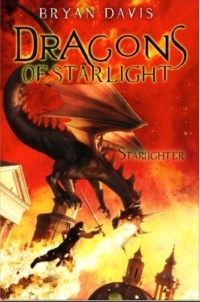
As a huge fan of Bryan Davis' Dragons in Our Midst/Oracles of Fire series and the Echoes from the Edge trilogy (I spend more time on his forum then on Facebook), I eagerly anticipated the release of Starlighter.
One aspect of the story that will immediately surprise readers of DioM is the presence of inherently evil dragons. But instead of traditional treasure-hording, maiden-devouring beasts, the dragons of Starlight enslave humans to mine extane, a gas necesscary for dragons to breath.
Meanwhile, on another planet, stories of the "Lost Ones" who were stolen by dragons and taken to another planet are laughed at as myths, but the young swordsman Jason Masters is forced to make a difficult decision when he discovers the legends are true.
Although the twin settings of this book are different from the mixed modern realistic of Davis' prior series, I found both of the worlds delightfully fresh and exciting. The mixture of modern and medieval technology in Jason's world raises questions for the next book in the series, and the characters are well-written and lovable.
Subscribe to:
Posts (Atom)