Showing posts with label thursday next. Show all posts

Wednesday, July 10, 2013

Thrice-Told Tales: We're all stories in the End

"My dear Elinor, you were obviously born into the wrong story,” said Dustfinger at last.
 I read a short story once in which the protagonist realizes he's fictional after another character points out that people in books never read books.  While that may be an interesting observation, it's no longer true in the world of modern fiction--or metafiction, as the case may be.
Metafiction is a device that involves characters who acknowledge the roles and tropes of storytelling to various degrees. It also can be invoked by setting stories inside each other.

One of the better-known examples of metafiction is The Princess Bride, both the film and book versions. The book is even more of a mindscrew than the movie, as the narrator elaborates on how his father used to read the book to him as a child, and the struggles he went through to abridge the book and so on. The movie is set up in a similar fashion, with the grandfather interjecting occasional comments such as "she doesn't get eaten by the shark at this time."  If you haven't seen the movie, I won't spoil it for you--just go and see it!
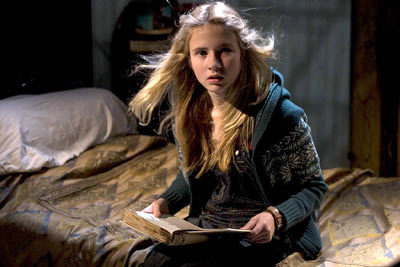
Another story with metafictional elements is the Inkworld trilogy by Cornelia Funke.  The first novel,  Inkworld,  has been adapted into a mediocre film, but the books are better.  Meggie lives with her bookbinder father when a strange man named Dustfinger  appears outside their home, warning them about someone named Capricon.  It turns out that Meggie's dad can read characters out of books, but at a cost--something--or someone--from our world must return to replace them. Not only does each chapter open with  quotes, but there are several shout-outs to other works, such as main characters exchanging notes in in Elvish runes.

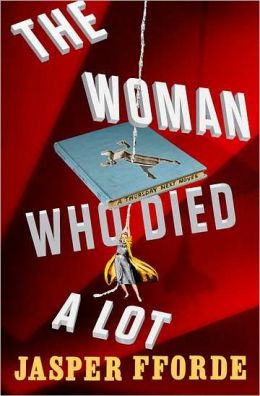
Finally, the Thursday Next series is one of the most hilarious books I've ever read. The main character develops the ability to jump in and out of fictional realms, from Jane Eyre to Great Expectations, but  that's just the beginning. There are also dodos, Neanderthals,  time travel, and maps of the Bookworld, with tons of shoutouts.

Thursday, September 27, 2012

Metafiction and Reader Interaction: The World of Thursday Next


On one of my recent trips to the libary, I rediscoved Jasper  Fforde’s Thursday Next series. The first book, The Eyre Affair,  is set in an alternate-history England circa 1980, occurs in a world where cheese smugglers run the line between Wales and Britain,  Bacon apologists go from door to door, and the main character is a veteran of the Russian-English conflict in the Crimera.  But the story really gets going once Thursday’s uncle Mycroft opens a portal into the Bookworld…
Generally, I would recommend British authors any day for their wit, brief yet clear detail, and skill in sci-fi and fantasy. Fforde is no exception. Frequent shoutouts for stories from Kipling to Doctor Who fill the story, and the first novel revolves extensively around an alternate ending for Jane Eyre. The story involves several levels of metafiction—story that is actively aware of itself as a story.  By the sixth or seventh book, One of Our Thursdays is Missing, a fictional version of the main character goes to search for the main character and ends up rewriting her series to contain the truth of the Bookworld.  There are also frequent references to Jurisfiction, the internal law system of the Bookworld. 
Many discussions in Jurisfiction mirror real-world ideas.
“For many readers books are too much of a one-sided conduict of information, and a new form of novel that allows the reader to choose where the story goes is the way forward.
“Isn’t that the point of books?” asked Black Beauty, stampling his hoof angrily on the table and upsetting an inkwell. “The pleasure lies in the unfolding of the plots. Even if we know what must happen, how one arrives there is still entertaining.”
”(…)create a new form of book—an interactive book that begins blank except for ten or so basic characters. Then, as it is written, chapter by chapter, the readers are polled on whom they want to keep and whom they want to exclude. As soon as we know, we write the new section, and at the end of the new chapter we poll the readers again (…)we want to make books hip and appealing to the youth market. Society is moving on, and if we don’t move with it, books—and we—will vanish.”
—-First Among Sequels, a Thursday Next novel
Another example of this creeping phenomena is the existance of sites like Book By You. Clients simply fill in name, physical attributes, and minor charactertics, and then pay for the product. If that’s what people read, I’d rather they watch a well-scripted TV show with character development, such as Doctor Who. Another discussion of changes in book formats can be found here. As an author, I prefer plain, ordinary paperbacks, a reliable format that doesn’t need batteries or have breakable screens. 
As for metafiction, it can be overdone very easily, but when done well, I absolutely adore it.